This course provides DBA students with a comprehensive understanding of how organizations navigate transformation and manage change in today’s dynamic business environment. It offers an in-depth exploration of the classic and contemporary theories, frameworks, and research methods underpinning organizational transformation and change management. Students critically examine the drivers, dynamics, and outcomes of change within complex organizations, with particular attention to leadership, culture, and stakeholder engagement. By engaging with real- world cases and academic literature, students will build advanced capabilities to assess, design, and contribute to evidence-based change initiatives relevant to modern organizational challenges.
Course learning outcomes
Upon successful completion of this course, students will be able to:
- Critically evaluate classic and contemporary change theories to determine their applicability and limitations in navigating modern organizational change.
- Analyze the interplay between organizational culture, leadership, and power dynamics to identify the underlying drivers of resistance and transformation levers.
- Assess the impact of informal networks and relational behaviors on managerial practices within international and cross-cultural contexts.
- Synthesize complex case study data to diagnose why transformation efforts fail and propose strategic solutions.
- Develop an advanced framework for continuous organizational agility, moving beyond episodic change to build organizations that are inherently ‘built to change’.
This course is facilitated by three instructors:
- Pr. Yoann Bazin, Université Paris Nanterre
- Dr. Nino Tandilashvili, ISC Paris
- Dr. Fadi Alsarhan, ISC Paris

February 20, 2pm-5pm: Introduction and framework
Discussion on the traditional opposition between stability and change, and that reminder that « into the same river you could not step twice » (Heraclitus). Insistance on the importance of routines when it comes to ontological security (Gidden (1991). Definition of organizational routines as practical accomplishments that can be sources of change through repairing, expanding and striving (Feldman, 1991).
Moneyball: « The Oakland Athletics of Major League Baseball have difficulty fielding competitive teams due to low revenue and owners who are reluctant to spend money. General manager Billy Beane drafts and develops cheap, young, and talented players, but the Athletics lose the 2001 American League Division Series (ALDS) to the New York Yankees, baseball’s richest and most successful team. For the 2002 season, Beane is given a paltry $41 million budget. Through free agency, three richer teams poach three of Beane’s best players: Jason Giambi, Johnny Damon, and Jason Isringhausen. Adding insult to injury, Giambi joins the Yankees. Beane is skeptical about traditional baseball scouting methods after the New York Mets drafted him in the first round of the 1980 draft—prompting Beane to decline a Stanford scholarship—only for Beane to have an unimpressive playing career » (Wikipedia)
Using Feldman’s (2000) categories of routine repairing, expanding and striving, unpack the tensions between Billy Beane and his team of scouts. Storytelling aside, who would you generally side with in these situations?
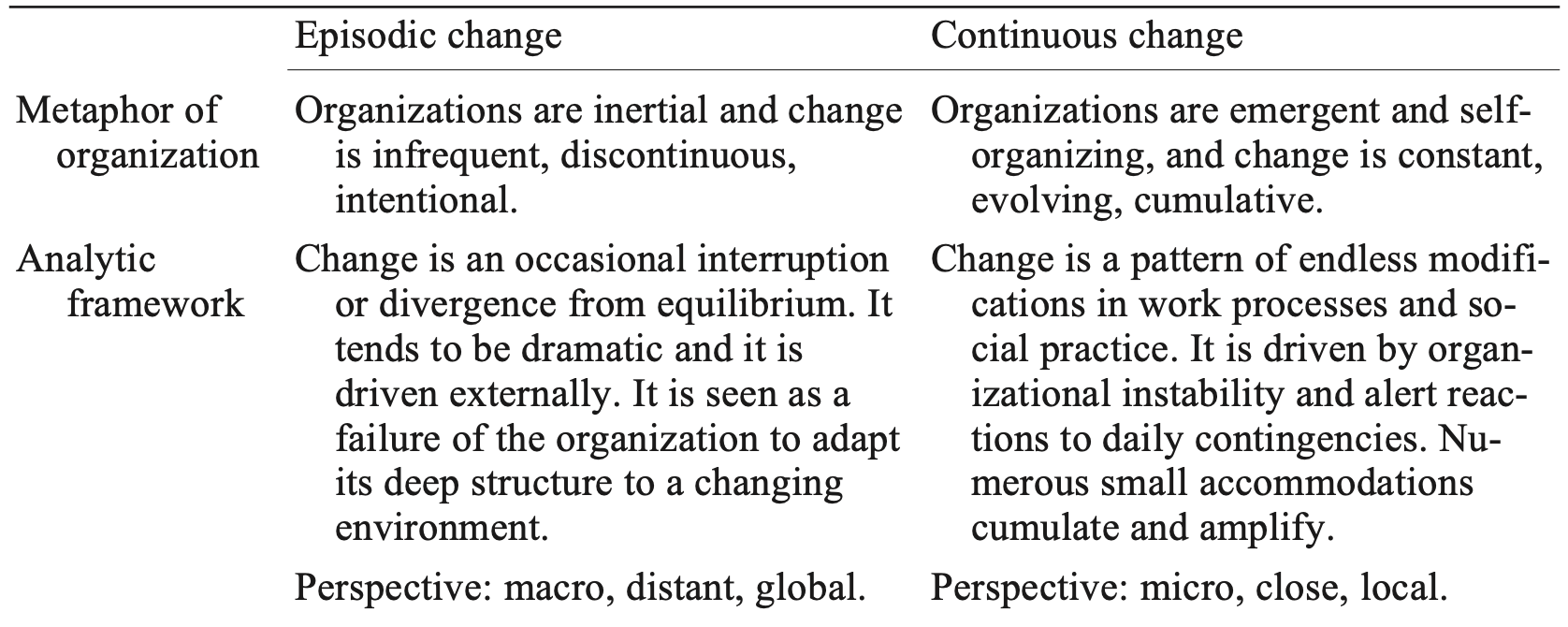
Why is change such a threat to the status quo? (Lewin, 1951). Unpacking the idea that « you cannot understand a system until you try to change » (Schein, 1996, p. 34). « It follows that there are two different types of change: one that occurs within a given system which itself remains unchanged, and one whose occurrence changes the system itself » (Watzlawick et al, 1974). Distinction between episodic and continuous change (Weick & Quinn, 1999).
- « The phrase ‘episodic change’ is used to group together organizational changes that tend to be infrequent, discontinuous, and intentional. The presumption is that episodic change occurs during periods of divergence when organizations are moving away from their equilibrium conditions. Divergence is the result of a growing misalignment between an inertial deep structure and perceived envi- ronmental demands. This form of change is labeled ‘episodic’ because it tends to occur in distinct periods during which shifts are precipitated by external events such as technology change or internal events such as change in key personnel » (Ibid, p. 365)
- « The phrase ‘continuous change‘ is used to group together organizational changes that tend to be ongoing, evolving, and cumulative (…) The distinctive quality of continuous change is the idea that small continuous adjustments, created simultaneously across units, can cumulate and create substantial change. That scenario presumes tightly coupled interdependencies. When interdependencies loosen, these same continuous adjustments, now confined to smaller units, remain important as pockets of innovation that may prove appropriate in future environments » (Ibid., p. 375).
Next steps:
- (Re-)read Kotter (2007) Leading Change – Why transformation efforts fail. Harvard Business Review
- Next week (Feb 27&28): « Change management and models » and « Culture and motivation » (instructor: Nino Tandilashvili)
- March 6: « Leadership and followership » (instructor: Yoann Bazin)
- Reading assignment: “Theranos” case study, and Garvin & Roberto (2007) Change through persuasion. Harvard Business Review
March 6, 2pm-5pm: Leadership and followership
Reminder on Weick & Quinn’s (2000) continuous and episodic changes:
Moneyball: « Beane tries to trade for the Cleveland Indians’ Karim García, but Cleveland refuses on the advice of team advisor Peter Brand, a Yale economics graduate who privately complains to Beane that Cleveland rarely takes his advice, and expresses a belief that baseball teams focus too much on individual players to have success. Intrigued, Beane asks whether Brand would have drafted him in 1980. After Brand reluctantly admits that he would not have drafted Beane until the ninth round, Beane hires Brand. Beane and Brand study sabermetrics, an unconventional scouting philosophy. Unable to afford more talented, expensive players, Beane and Brand focus on maximizing the team’s on-base percentage (OBP) and compromise on skills like base stealing, defense, and batting average. They acquire undervalued players like aging David Justice, injured catcher Scott Hatteberg, and submariner Chad Bradford. Beane fires head scout Grady Fuson, who refuses to abandon his traditional scouting methods. A poor start to the season prompts the media and the team to question Beane’s philosophy. Manager Art Howe, who is angling for a contract extension, disregards Brand’s advice to put the players with the best OBP at the top of the batting order » (Wikipedia)
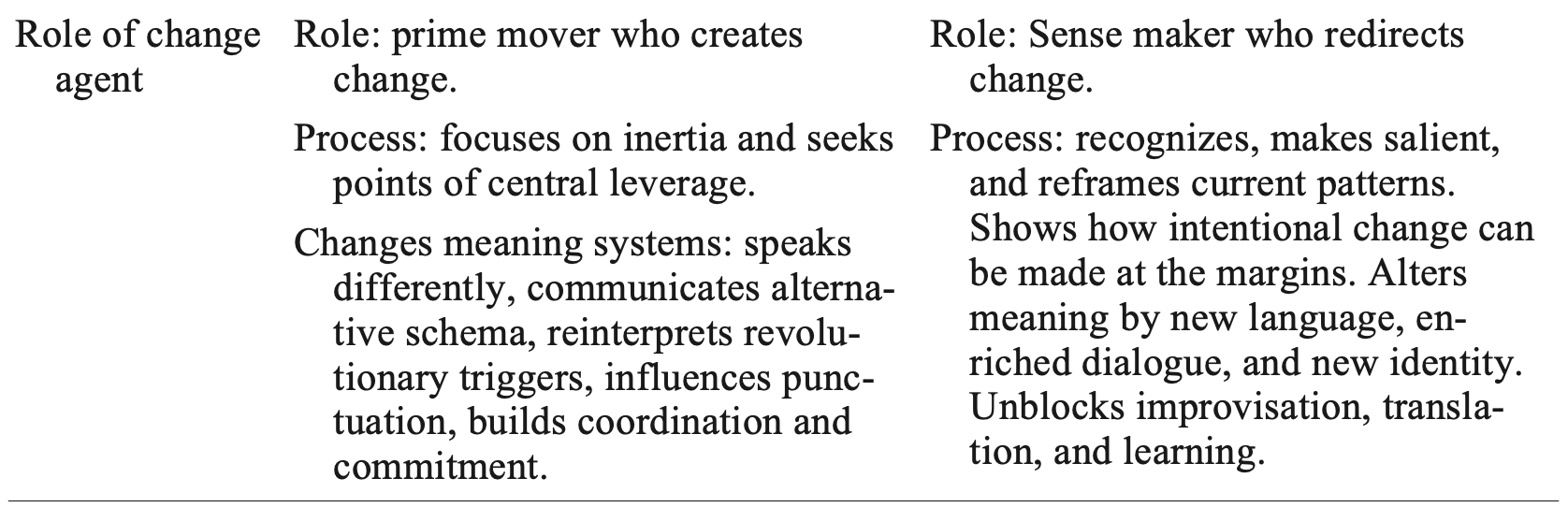
Using the Weick & Quinn’s (1999) distinction between continuous and episodic change, identify the multiple roles played and the issue of divergence in objectives and discrepancies in paces. From your experience in these different roles, is anyone ‘in the wrong’ here?
Reminder that « there is no one ‘ideal model of an effectively functioning organization' » (Weick & Quinn, 1999, p. 370). There are more or less coherently integrated roles though:
Behind it all, it is a matter of pace and scale. Transformation as a specific form of change:
- « Adaptive changes are small, incremental adjustments that organizations and managers make to adapt to daily, weekly, and monthly business challenges »
- « Transformational change, on the other end of the spectrum, refers to changes that are typically much grander in scope than incremental, adaptive changes. Very often, transformational change refers to a dramatic evolution of some basic structure of the business itself—its strategy, culture, organization, physical structure, supply chain, or processes » (HBS)
John Kotter’s two cents: « Well over 50% of the companies I have watched fail in this first phase. What are the reasons for that failure? Sometimes executives underestimate how hard it can be to drive people out of their comfort zones. Sometimes they grossly overestimate how successful they have already been in increasing urgency. Sometimes they lack patience: ‘Enough with the preliminaries; let’s get on with it.’ In many cases, executives become paralyzed by the downside possibilities. They worry that employees with seniority will become defensive, that morale will drop, that events will spin out of control, that short-term business results will be jeopardized, that the stock will sink, and that they will be blamed for creating a crisis.
A paralyzed senior management often comes from having too many managers and not enough leaders. Management’s mandate is to minimize risk and to keep the current system operating. Change, by definition, requires creating a new system, which in turn always demands leadership. Phase one in a renewal process typically goes nowhere until enough real leaders are promoted or hired into senior-level jobs » (Kotter, 2007, p. 5)
How does Kotter’s (2007) considerations apply to Billy Bean’s approach to transforming the Oakland Athletics? What did he do right so far that you wouldn’t have done yourself? What mistakes did he do that you genuinely think you would have avoided? What should he do next?
The role of strategic thinking and improvisation in organizational transformation (Mintzberg).
Themes: Understanding leadership as a collective phenomenon (Uhl-Bien et al). The role of followers and followership (Kellerman). From leadership to leaderful practices (Raelin). Definitions of destructive and unethical leadership (Howell & Avolio). Ethical leadership.
Reading assignment: “Theranos” case study, and Garvin & Roberto (2007) Change through persuasion. Harvard Business Review
Case and illustrations: Extracts from “The Founder”, “Steve Jobs”, and the “Theranos” case study
 Yoann Bazin