Feldman (2000) Organizational Routines as a Source of Continuous Change
I claim that organizational routines are still underappreciated because their potential for change has not been sufficiently explored. In this paper I present observations of routines that altered my understanding of their potential for change. I began my fieldwork in a student housing de- partment of a large state university with the idea that organizational routines are repeated patterns of behavior that are bound by rules and customs and that do not change very much from one iteration to another (…)
Ideas produce actions, actions produce outcomes, and outcomes produce new ideas, it is the relationship between these elements that generates change. The fit between the ideas, actions, and outcomes is not always tight. Ideas can generate actions that do not, in fact, execute the ideas. Actions can generate outcomes that make new and different actions possible or necessary. The outcome could, for instance, be a disaster that encourages one to try something different next time. Outcomes, in turn, can generate new ideas.
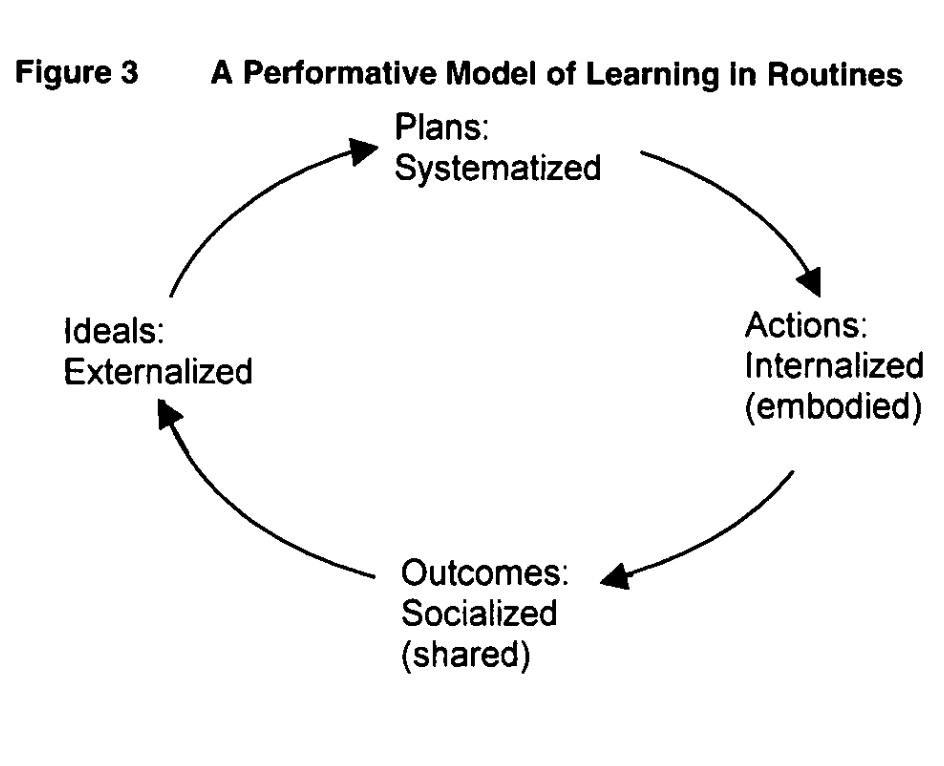
Dynamics of Routines
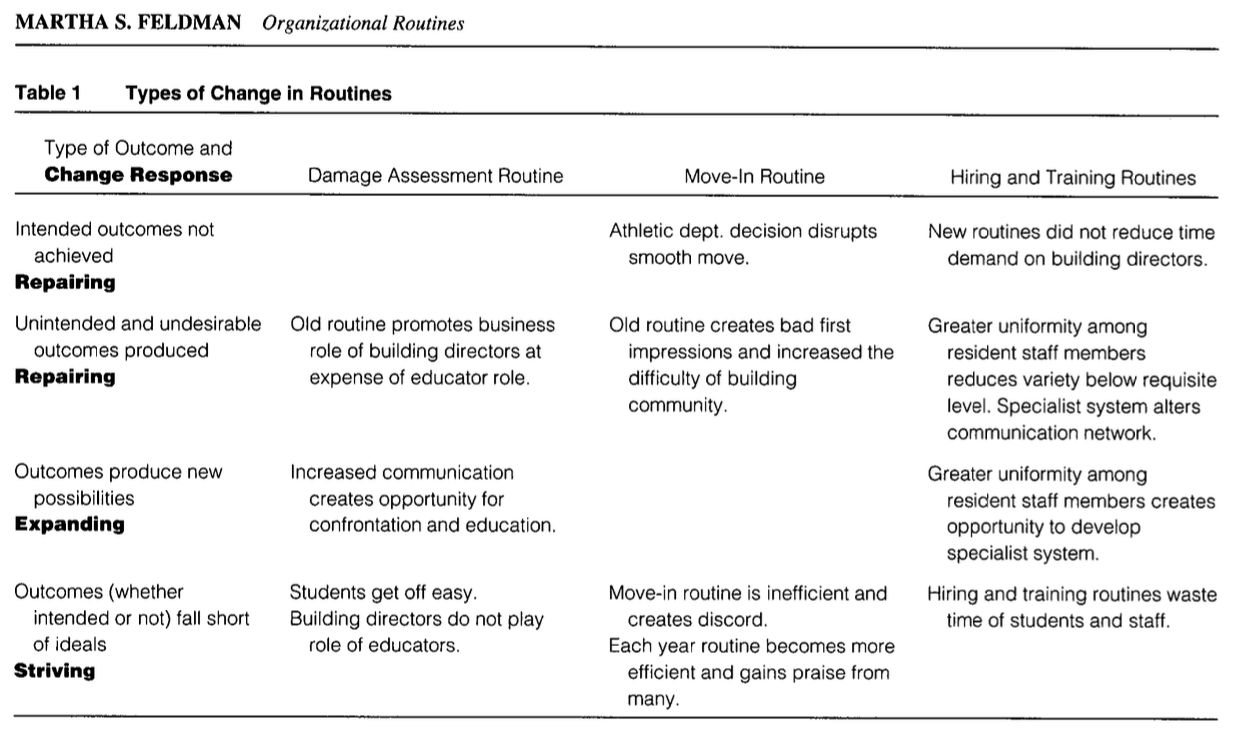
Participants in routines sometimes change them. My observations of routines suggest that this occurs for several reasons. These reasons are related to different kinds of outcomes. One reason is that sometimes actions do not produce the intended outcomes. Another is that sometimes actions produce outcomes that create new problems that need to be solved: Actions produce unintended and undesirable outcomes. A third reason is that rather than producing problems, actions can result in outcomes that produce new resources, and therefore enable new opportunities (Feldman 2000). A fourth possibility is that the outcome produced is intended but that participants still see improvements that could be made. For the sake of brevity I refer to this as falling short of ideals. I use the term « ideals » for a broad category of normative influences that include values, goals, missions and expectations.
Each of these types of outcome is associated with a change response. When actions do not produce the intended outcome, or produce an unintended and undesirable outcome, participants can respond by repairing the routine so that it will produce the intended and desired outcome. The result may be to restore the routine to a stable equilibrium and may not be associated with continued change. When the outcomes enable new opportunities, participants have the option of expanding. They can change the routine to take advantage of the new possibilities. Finally, when outcomes fall short of ideals, they can respond by striving. Unlike repairing, striving is, by definition, attempting to attain something that is difficult, if not impossible, to attain. People engaged in the routine continue to alter the routine so that it allows them to do the job in a way that seems better to them. For instance, one may strive to be a better teacher, but having achieved this goal, one can strive to be a better teacher yet. Because the standard is continuously changing, it can never be achieved. Both expanding and striving have a high potential for continuous change because of their relation to what is desirable. Both affect routines in an ongoing way because they alter the standard for doing work.
 Yoann Bazin