Lewin (1951) Chapter 9 Frontiers in Group Dynamics
1 Constancy and Resistance to Change
It is important to distinguish two questions which are generally not sufficiently separated, the one concerns actual change or lack of change, the other concerns resistance to change. A given group may show little change during a period of, let us say, two weeks. The group may be composed of friends on an island in the middle of their vacation, or a work team in a factory. Let us assume that the conditions under which this group lives happen to stay constant during this period: no individual leaves or joins the group, no major friction occurs, the facilities for activities or work remain the same, etc. Under these circumstances the constancy of group life – for instance, the unchanged level of production – does not require any other “explanation” than the reference to the principle: the same conditions lead to the same effect. This principle is identical with the general idea of lawfulness of group life.
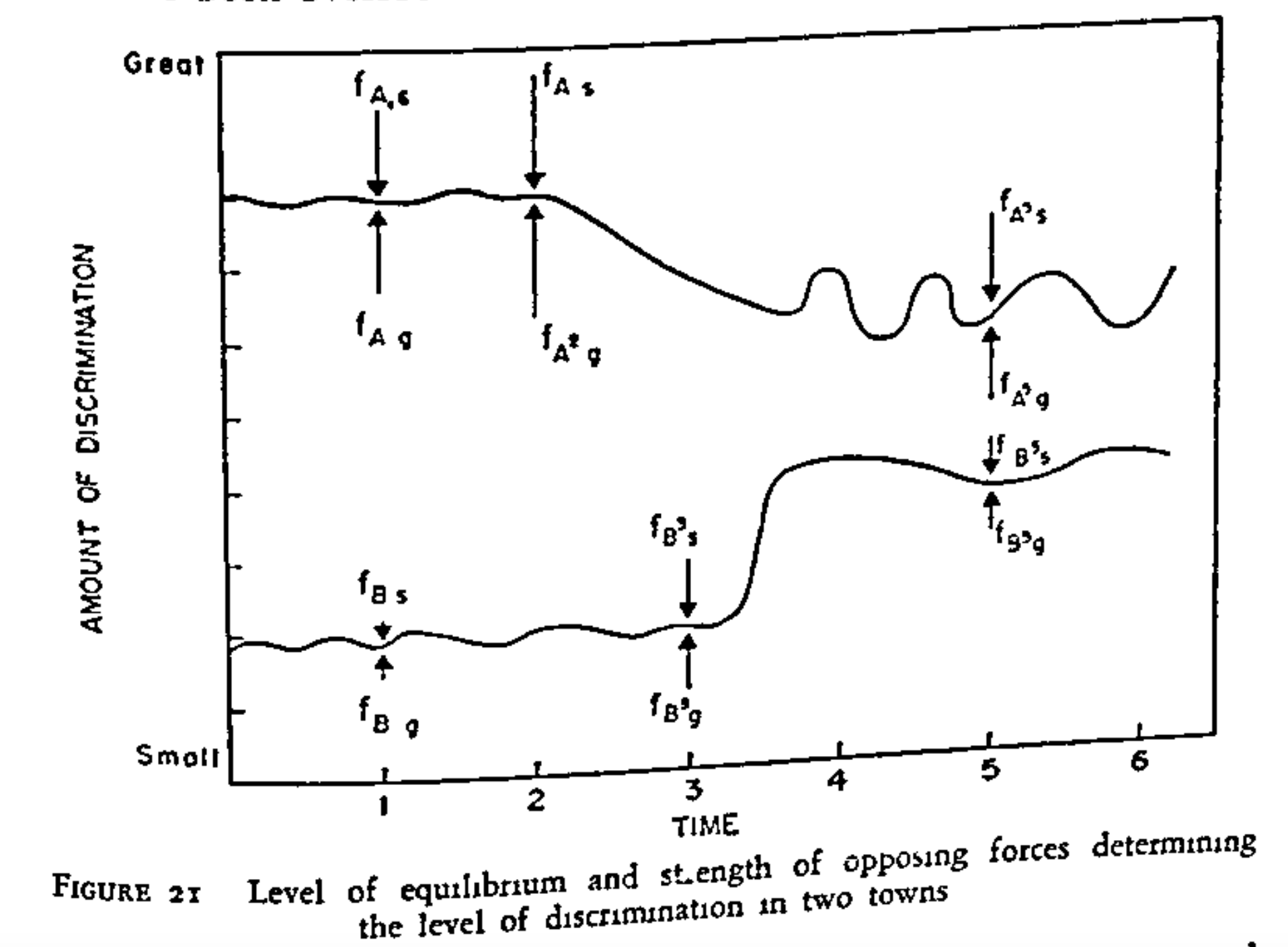
The case would be different if the production level of the work-team were maintained in spite of the fact that a member of the work-team took sick or that inferior or superior material was provided. If, in spite of such changes in the group like setting, production is kept at the same level, then can one speak of “resistance’ to change of the rate of production. The mere constancy of group conduct does not prove stability in the sense of resistance to change, nor does much change prove little resistance. Only by relating the actual degree of constancy to the strength of forces toward or away from the present state of affairs can on speak of degrees of resistance or ‘stability’ of group life in a given respect.
The practical task of social management, as well as the scientific task of understanding the dynamics of group life, requires insight into the desire for and resistance to, specific change. To solve or even formulate these questions adequately we need a system of analysis which permits the representation of social forces in a group setting. The following considerations are directed more toward the improvement of these analytical tools than toward the analysis of a particular case.
2 Social Fields and Phase Spaces
A basic tool for the analysis of group life is the representation of the group and its setting as a “social field.” This means that the social happening is viewed as occurring in, and being the result of, a totality of coexisting social entities, such as groups, subgroups, members, barriers, channels of communication, etc. One of the fundamental characteristics of this field is the relative position of the entities, which are parts of the field. This relative position represents the structure of the group and its ecological setting. It expressed also the basic possibilities of locomotion within the field.
What happens within such a field depends upon the distribution of forces throughout the field. A prediction presupposes the ability to determine for the various points of the field the strength and directions of the resultant forces.
 Yoann Bazin