Archives pour la catégorie Uncategorized
Grocery bag case study
« Which grocery bag? » Assignment:
- Read the 2018 “Life Cycle Assessment of grocery carrier bags” report of the Ministry of Environment and Food of Denmark (Environmental Project n°1985). Pay particular attention to the life cycle of bags and the different End-of-life scenarios
- Compare the results between traditional (LDPE), solid recycled (PET), compostable (biopolymer), paper and cotton bags. Make a recommendation to a supermarket chain who is looking to redesign its carrier bag offer. Justify which impact categories you include, the end-of-life scenarios and the calculation.
- Conclude with recommendations on how to communicate about the new strategy with the different stakeholders (customers, employees, board, NGOs, press)
Life Cycle Assessment of grocery carrier bags (Ministry of Environment and Food of Denmark, 2018)
The Luntz memo
Frank Luntz Memorandum to Bush White House (2002)
LVMH – Le loup en cachemire
Sources
- Sur LVMH :
- Kerlau (2010) Les dynasties du luxe. Chapitre 6.
- Routier (2003) L’ange exterminateur – La vraie vie de Bernard Arnault. Chapitres 7 et 8.
- Sebag-Montefiore (1992) Kings on the catwalk – The Louis Vuitton and Moët-Hennessy affaire. Chapters 6 to 10.
- Villette & Vuillermot (2005) Portrait de l’homme d’affaire en prédateur. Chapitre 5.
- Le documentaire « Luxe, la fabrique du rêve » de France TV.
- Grille de lecture académique :
- Volle (2007). Prédation et prédateurs. Chapitre 1.
- Mesly, O., & Mangin, J. P. L. (2013). La théorie de la prédation en marketing: Une interprétation des comportements des agents de marché?. La Revue des Sciences de Gestion, 261262(3), 131-138.
Premier niveau d’analyse
- A partir de Kerlau (2010, Ch 6, partie 5) et Routier (2003, Ch 7 & 8), reconstituez les jeux d’alliance entre Henry Rocamier et Alain Chevalier d’abord, puis avec Bernard Arnault. Détaillez les raisons des rapprochements, les intérêts de chacun, puis éventuellement les motifs de distance, et les éventuelles tractations, négociations, promesses, et trahisons, depuis la création de LVMH jusqu’à l’entrée d’Arnault.
Second niveau d’analyse
- A partir de Volle (2007, Ch 1) et de Mesly & Mangin (2013), définissez ce que serait une ‘éthique du prédateur’ (sans idéaliser, ni diaboliser la prédation). Utilisez le cas de Bernard Arnault tel que décrit par Villette & Vuillermot (2005) pour illustrer.
Troisième niveau d’analyse
- Utilisez les grilles conceptuelles développées autour de la notion de prédation (Mesly & Mangin, 2013; Volle, 2007; Villette & Vuillermot 2005) pour analyser les jeux d’alliance de Bernard Arnault pour entrer au capital de LVMH. Reprenez pour cela en détail les données venant de Kerlau (2010) et Routier (2003) en ajoutant celles de Sebag-Montefiore (1992, Ch 6 à 10) et le documentaire « Luxe, la fabrique du rêve ».
- N’oubliez pas que dans le monde des affaires un même acteur peut-être à la fois prédateur et proie, et que les prédateurs ne sont pas forcément les ‘méchants’ et les proies des ‘gentils’. Des schémas présentant la constellation des acteurs et leurs relations pourraient vous aider à clarifier le propos.
- Pour conclure, répondez de manière argumentée à la question : Est-ce que Bernard Arnault mérite son surnom de ‘loup en cachemire’ ?
Koch Industries
Mayer (2016) Chapter 1
Schulman (2015, Ch 5)
Schulman (2015, Ch 6)
Schulman (2015, Ch 13)
EMN SBS 25-26 SasB

Sustainability as a business
Final assessment
- Collective 2,500-word essays (+/-10%)
- Sent as PDF to yoannbazin@yahoo.fr
- Must include at least 10 quotes from academic sources and 10 quotes from empirical material (with precise sources each time and a reference list)
- Figures and references are not part of the word count
- Your conclusion should take a position on the subject (it doesn’t have to be radical, but it has to state a position clearly on what to do or where to go from there)
- Subjects correspond to the ‘final integration’
- See assignments of December 11th
- Deadline: December 22nd
03/10 – Introduction
- 9h30-12h30 – Methodology
- Critical thinking
- Case: Margin call
- Evidence-based
- Case: The big short
- Critical thinking
10/10 – Sustainability, a history

- 9h30-11h30: Sustainability, a history
- 11h30-12h: An individual matter?
- WWF Footprint Calculator
- Debates and discussions
- 12h-12h30: Conclusion
17/10 – Beyond Petroleum?
- 9h30-10h30: BP case study
- 10h30-11h45: Revolving doors in the fossil fuel industry
- Presentation group C: What is the extent of revolving doors practices in the fossil fuel industry? (with a focus on BP)
- Deliverable: 2-page research note by email two days before, and 15-minute presentation during the class
- Sources: EU Parliament report and press articles about BP
- Presentation group A: How do Koch Industries use revolving doors to further their interests?
- Deliverable: 2-page research note by email two days before, and 15-minute presentation during the class
- Sources: Greenpeace reports and Open Secrets
- Presentation group C: What is the extent of revolving doors practices in the fossil fuel industry? (with a focus on BP)
- 11h45-12h30: Manufacturing consent
- Presentation group F: What were the recommendations made by Frank Luntz to US Republicans on how to talk about the environment?
- Deliverable: 2-page research note by email two days before, and 15-minute presentation during the class
- Source: The 2002 Luntz Memo
- Presentation group F: What were the recommendations made by Frank Luntz to US Republicans on how to talk about the environment?
- Conclusion on business & society (& sustainability)
07/11 – Sustainability vs. CSR
- Assignment for all groups: Read Friedman (1970)
- 9h30-11h: Problematizing CSR
- The spirit(s) of capitalism
- Debating Friedman (1970)
- From CSR1 to CSR2
- 11h15-12h: Complexifying CSR2
- Presentation Group B: The grocery bag case study
- Deliverable: 2-page research note by email two days before, and 15-minute presentation during the class
- 12h-12h30: (De)politicizing CSR
12/11 – Tutorials
- Group A – Prepare Unpacking the Kochtopus, Step 6
- Group B – Prepare Carbon accounting, Steps 2 & 3
- Group C – Prepare Revolving doors, Steps 1 & 2
- Group D – Prepare Carbon accounting and climate fictions, Steps 1 & 2
- Group E – Prepare Modern slavery, Steps 1 & 2
- Group D – Prepare Unpacking the Kochtopus, Step 4
14/11 – Carbon accounting
- 13h30-14h15: When frames collide
- 14h15-14h45: Presentation Group B
- Assignment: Summarize Kaplan & Ramana (2021)
- 14h45-15h30: Giti Tire case study
- 15h45-16h15: Presentation Group D
- Assignment: Summarize the first 3 months of Carbon Diaries, both at individual levels (Laura, her family, her friends and neighbours) and institutional levels (country, regulation, city, etc.)
- Sources: Lloyd (2008) Carbon Diaries
- 16h15-16h30: Conclusion
21/11 – The Ministry for the Future
- 9h30-10h15: Carbon Diaries
- Presentation Group D
- 10h15-11h45: Consulting for XR
- 12h-12h30: The Ministry for the Future
25/11 – Tutorials
28/11 – Unsustainability as a business
- Presentation Group A
- Presentation Group C
- Present Revolving doors, Steps 1 & 2
- Presentation Group F
- Present Chapter 6 of Merchants of doubt
11/12 – Research projects & Presentations
- Group A – Unpacking the Kochtopus, Final integration
- Group B – Carbon accounting, Final integration
- Group C – Revolving doors, Step 2 and a proposal for a concrete case in the gas & oil industry you would like to study specifically.
- Group D – Carbon accounting and climate fictions, Final integration (focusing on Carbon Diaries and The Ministry for the Future, not Ecotopia)
- Group E – Modern slavery, Step 2 and a proposal for a concrete case you would like to study specifically.
- Group F – Fostering climate doubt, Step 3 and a proposal for a concrete case in the gas & oil industry which sustainability communication you would like to study specifically.
Workgroups
EMN SBS 25-26 CG&BE

Business ethics and corporate governance
Final assessment
- Collective 2,500-word essays (+/-10%)
- Sent as PDF to yoannbazin@yahoo.fr
- Must include at least 10 quotes from academic sources and 10 quotes from empirical material (with precise sources each time and a reference list)
- Figures and references are not part of the word count
- Your conclusion should take a position on the subject (it doesn’t have to be radical, but it has to state a position clearly on what to do or where to go from there)
- Subjects correspond to the ‘final integration’
- See assignments of December 11th
- Deadline: December 22nd
03/10 – Introduction
- 13h30-16h30 – Conceptual framework
10/10 – Governance & Strategy
- 13h30-14h30: Strategic evels
- The levels of strategy
- Case: Margin call
- 14h30-16h30 – Mapping out corporate governance
- Case: Too big to fail
17/10 – Strategy and governance of Koch Industries
- Assignment for Groups C & D: Read Mayer (2016, Ch 1)
- 13h30-14h15: The history of Koch Industries (Group A)
- Who is Charles Koch? Present his background, the history of Koch Industries and the structure of the governance of the company. Analyze the role played by Charles Koch’s political views and values in the strategy of the company.
- Deliverable: 2-page research note vy email two days before, and 15-minute presentation during the class
- Sources: Schulman (2015, Ch 5 & 6), and Mayer (2016, Ch 1)
- 14h15-15h45: Collective analysis of the ‘Kochtopus‘
- Introduction: Why build ‘Kochtopus’?
- Each group reads a different source
- Group A: Schulman (2015, Ch 6 & 13) and Mayer (2016, Ch 5)
- Group B: Mayer (2016, Ch 5, 6, 7 & 8)
- Group C: Mayer (2016, Ch 6, 7 & 8) and Leonard (2019, Ch 19)
- Group D: Leonard (2019, Ch 19) and Schulman (2015, Ch 6 & 13)
- Each time you encounter an organization (firm, university, think tank, NGO, …) that is directly linked to Koch Industries or the Koch brothers, fill out this form.
- Debriefing: Mapping out the Kochtopus
- 15h45-16h30: Presentation of the Koch brothers’ network (Group B)
- Explain why it is relevant to analyze the network of the Koch brothers. Present the sources and methods used for the network analysis. Detail the results and the importance of the most salient ones.
- Deliverable: 2-page research note by email two days before, and 15-minute presentation during the class
- Source: Doreian & Mrvar (2021)

07/11 – Governance, strategy and ideology
- 13h30-15h: Management as an ideology
- What is an ideology?
- History and ethics of managerialism
- Management as a de-politicizing ideology
- 15h30-16h30: The Kochtopus as robust action
- The Koch brothers’ ideological plan (Group A)
- Introduce Richard Fink, his career and his role in the Koch galaxy. Present the main arguments of the article (Fink, 1996). Use your previous work and Doreian & Mrvar’s (2021) analysis to explain how Fink’s ideological strategy structured the Kochtopus.
- Deliverable: 2-page research note by email two days before, and 15-minute presentation during the class
- Sources: Fink (1996) and Doreian & Mrvar (2021)
- Robust action strategy
- The Koch brothers’ ideological plan (Group A)
14/11 – Whistleblowing at Theranos
- 9h30-10h45: Presentations
- Group D: Presentation of Wood et al (2022), linking it to the Theranos case study.
- Deliverable: 2-page research note by email two days before, and 15-minute presentation during the class
- Group C: Presentation on Elizabeth Holmes’ defence strategy
- What were Elizabeth Holmes’ different defence strategies during the trial? How solid were they? How likely were they to succeed? In particular, underline the claims and arguments she used to justify that she was not responsible and/or could not be held accountable of what happened in Theranos. Pay attention to the diffusion strategies (how she blames other) and their organizational aspects (delegation of responsibility, size of the company, lack of experience or expertise, etc.).
- Deliverable: 2-page research note by email two days before, and 15-minute presentation during the class
- Sources: Theranos case study, along with episodes “Bombshell” and “Setting the stage” of ABC’s podcast The Drop Out, and episode 1 (“The Sympathy Play”) of the podcast Bad Blood: The Final Chapter
- Group B: Presentation of the whistleblowing of Erika Cheung and Tyler Schultz
- Present Thomas’ (2020) network perspective on whistleblowing. Use his mode of presentation (in particular: Figures 1, 2 & 3) to map out the whistleblowing journey of Erika Cheung and Tyler Schultz
- Deliverable: 2-page research note by email two days before, and 15-minute presentation during the class
- Sources: Thomas (2020), Carreyrou (2015, Ch. 16 to 21) and the Theranos case study
- Group D: Presentation of Wood et al (2022), linking it to the Theranos case study.
- 11h-12h: Collective analysis of Theranos’ whistleblowing threads
- Group A focuses on the early issues raised in Theranos. Based on Carreyrou’s (2015) Chapter 1 to 4, follow precisely how Ana Ariola and Avie Tevanian came to be concerned and how they voiced these concerns internally. List the other actors and organizations that were involved in the process of understanding the issues (see Template below). Analyze the reactions of the organization, Elizabeth Holmes in particular but also Don Lucas and other executive or board members for example. Map these encounters following the template below.
- Group B will focus on the final threads around John Carreyrou’s publication. Based on Carreyrou’s (2015) Chapters 19, 21 and 23, reconstruct how John Carreyrou came to know about Theranos, how he confirmed the statements. Analyze in particular who he met, how he found them and how he slowly built the case – account also for people and organization that tried to stop him or change his mind.
- Group C: will focus on Ian Gibbons. Based on Carreyrou’s (2015) Chapters 12, 14, 19 and 21, follow precisely how Ian Gibbons came to be concerned and how they voiced these concerns internally. List the other actors and organizations that were involved in the process of understanding the issues (see Template below). Analyze the reactions of the organization, Elizabeth Holmes in particular but also Sunny Balwany or the company’s lawyer for example. Map these encounters following the template below.
- Group D will focus on Richard Fuisz Based on Carreyrou’s (2015) Chapters 5, 11, 18 and 19, follow precisely how Richard Fuisz came to be interested in Theranos and how he later voiced his concerns externally. List the other actors and organizations that were involved in the process of understanding the issues (see Template below). Analyze the reactions of the organization, Elizabeth Holmes in particular but also Sunny Balwany or the company’s lawyer for example. Map these encounters following the template below.
- Template for the mapping out of interactions
- Confirmation: Place the interactions that contributed to moving the whistleblowing forward (confirmation, validation, encouragement, …) with the name of the person involved and the date
- Contradiction: Place the interactions that slowed down the whistleblowing process (challenges, counter-arguments, punishments, threats, …) with the name of the person involved and the date.
- See example below:

- 12h-12h30: Conclusion
21/11 – Organization & Ethics
- 13h30-14h30: What is ethics?
- 14h30-15h: The dangers of slippery slope:
- Group D: Presentation of Theohadraki et al (2021) with a focus on the slippery slope and moral disengagement.
- Deliverable: 2-page research note vy email two days before, and 15-minute presentation during the class
- Group D: Presentation of Theohadraki et al (2021) with a focus on the slippery slope and moral disengagement.
- 15h15-16h30: Collective analysis of Silicon Valley (HBO)
- Each group watches its assigned episode and analyzes it based on: moments of hesitation and debate about a decision to make, dilemmas, negotiations, arguments.
- Group A: S03E10 / Group B: S04E09 / Group C: S04E10 / Group D: S02E09
- The aim is to identify the principles and values behind these moments, and to use Theohadraki et al’s (2021) framework to identify moments of slippery slope (see below).
- In the end, pick one extract (2-3 minutes max) to show the rest of the class and show your analysis.
- Each group watches its assigned episode and analyzes it based on: moments of hesitation and debate about a decision to make, dilemmas, negotiations, arguments.

- Illustration with Season 1, Episode 1:
25/11 – Tutorials
28/11 – Accountability and responsibility at Wells Fargo
- 13h30-14h45: Presentations
- Group C: Analysis of Stumpf’s blame-game strategies
- Based on Roulet & Pichler’s (2020) blame-game theory, present the four main pathways theyr identify. Analyze Joe Stumpf’s defence during his opening address and answers to the House of Representatives (14’50-31’00) by identifying his rhetorical strategies (see example below). Using Roulet & Pichler’s (2020), shed a light on Stumpf’s attempt at cultivating « high attributional ambiguity » to avoid « Pathway D ».
- Deliverable: 2-page research note vy email two days before, and 15-minute presentation during the class
- Sources: Roulet & Pichler (2020), the Wells Fargo case study and the Senate hearing on « Wells Fargo Unauthorized Accounts »
- Group D:
- Example of analysis of rhetorical strategies (these three categories are just an illustration, more should be found):
- Group C: Analysis of Stumpf’s blame-game strategies
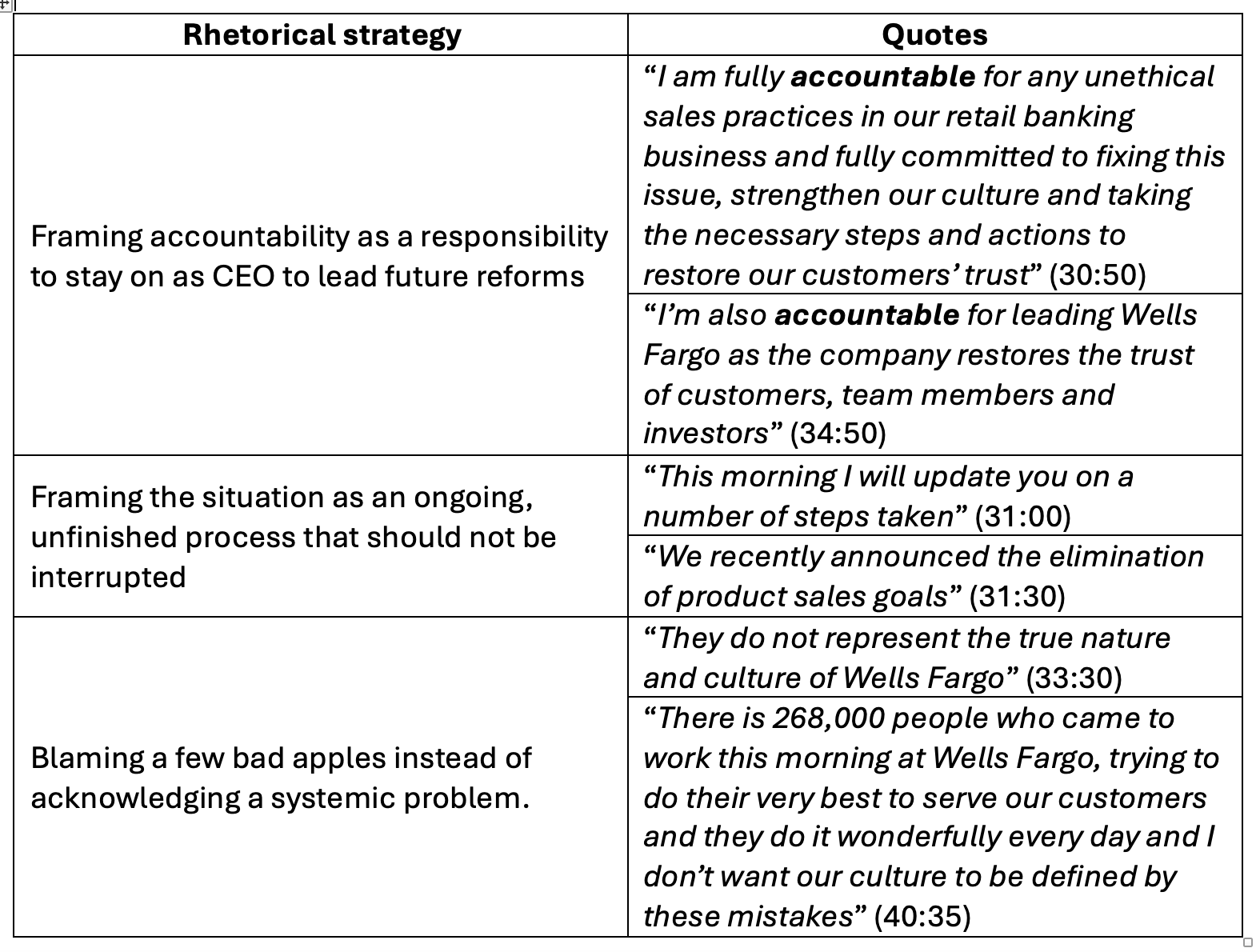
- 15h-16h: Collective analysis of Joe Stumpf’s rhetorical strategies
- Based on the analytical grid provided by Group C, each group analyzes a portion of Joe Stumpf’s testimonie in the front of the Senate. Bonus will be given to groups identifying strategies that Group C did not notice.
- Group A: Analysis of Stumpf’s answers to Representarives Randy Neugebauer and Carolyn Maloney (31’15-42’30), Patrick McHenry and Nydia Velazquez (42’35-53’00), and Scott Garrett and Brad Sherman (53’10-1’03’50)
- Group B: Analysis of Stumpf’s answers to Representarives Blaine Luetkemeyer and Gregory Meeks (1’04’00-1’14’30), Sean Duffy and Michael Capuano (1’14’40-1’25’20), and Ed Royce and Stephen Lynch (1’25’30-1’36’30)
- Group C: Analysis of Stumpf’s answers to Representarives Frank Lucas and David Scott (1’36’30-1’47’10), Steve Pearce and Al Green (1’47’20-1’58’10), and Bill Posey and Emanuel Cleaver (1’58’15-2’08’50)
- Group D: Analysis of Stumpf’s answers to Representarives Michael Fitzpatrick and Gwen Moore (2’08’50-2’19’25), Marlin Stutzman and Keith Ellison (2’19’25-2’29’40), and Mick Mulvaney and Ed Perlmutter (2’29’40-2’40’10)
- 16h-16h30: Responsability and accountability in modern organizations
11/12 – Presentations of research projects
- Group A: Analysis of the structure of the Kochtopus
- Going back to Fink (1996) and using it as a structure, complete the collective analysis of the Kochtopus done in class adding data from Schulman (2015, Ch 5, 6 & 13), Mayer (2016, Ch 5, 6, 7 & 8) and Leonard (2019, Ch 19).
- Complete this figure and use it as the center of your presentation.
- Group B: Analysis of whistleblowing at Theranos
- Going back to Thomas (2020) as a representation of whistleblowing, complete the collective analysis of Theranos’ whistleblowers done in class adding data from the early issues raised in Theranos (Carreyrou’s (2015) Chapter 1 to 4), Ian Gibbons (Carreyrou’s (2015) Chapters 12, 14, 19 and 21), Richard Fuisz (Carreyrou’s (2015) Chapters 5, 11, 18 and 19), and the final threads around John Carreyrou’s publication (Carreyrou’s (2015) Chapters 19, 21 and 23).
- Complete this figure and use it as the center of your presentation.
- Group C: Analysis of Wells Fargo blame-game strategie
- Going back to Roulet & Pichler (2020) as a analytical grid, complete the analysis of Stumpf’s testimony before the US Senate , adding data from all his answers during the Senate hearing on « Wells Fargo Unauthorized Accounts ».
- Map out his answers on Roulet & Pichler’s (2020) grid (in particular Figure 1) and use it as the center of your presentation.
- Group D: Analysis of Fake it ’till you make it
- Going back to Theohadraki et al (2021) as a analytical grid, complete the collective analysis of Silicon Valley in class adding your own analysis of Richard Hendricks during Seasons 3 and 4 of the TV show.
- Use the 8 types of moral disengagements (Table 1) as analytical categories to classify your data and use it as the center of your presentation.
12/12 – Integrating levels in the fog of war
- 13h30-14h: Strategic thinking
- 14h-14h30: Military strategy in the fog of war
- 14h30-16h: Waterloo
Workgroups
Marchand (2001) Les guerres du luxe
Chapitres 6, 7, 8 et 9
Gay Forden (2021) House of Gucci
Chapitres 5, 19 et Postface
Kerlau (2010) Les dynasties du luxe
Chapitre 4 – Gucci
Chapitre 6 – Louis Vuitton

